
Your Cart is Empty



Last Updated: October 14, 2026
Finding the best metal detector for Australian soil comes down to understanding what makes your local ground so challenging. Australia's highly mineralized soils, hot rocks, and electromagnetic interference create conditions that confuse detectors designed for overseas conditions.
The real problem isn't that good detectors don't exist. It's that most guides treat all soil as equal when Australian goldfields demand something entirely different. Mineralized ground that works fine for detectors in North America or Europe will cause constant false signals here. Ground noise, hot rocks, and electromagnetic interference are facts of life in Australian prospecting, but they're manageable if you choose equipment built to handle them.
This guide covers what actually matters when selecting a detector for your conditions: soil type, technology choice, budget, and experience level. We'll show you how to identify your local soil challenges, explain why pulse induction and VLF technology perform differently in mineralized ground, and walk you through the detectors that deliver real results.
| Detector | Technology | Best For | Price Range | Key Strength |
|---|---|---|---|---|
| Nokta Magnetar 9000 | Advanced PI | Harsh mineralized ground, deep & small gold | $7,999 | Dual-receiver coils, submersible, firmware updatable |
| USED Minelab GPX 6000 | GeoSense-PI | All gold sizes in mineralized soil | $7,995 | Lightweight, automatic ground balance, proven depth |
| USED Minelab GPZ 7000 | PI | Serious prospectors, maximum depth | $7,500 | 40% more depth than GPX, 256 noise cancel channels |
Picking the right detector starts with honest assessment of your ground. Not all Australian soil is the same, and not all detectors handle mineralization equally. The wrong choice wastes money and time; the right one turns difficult ground into an advantage because fewer people will have the equipment to work it effectively.

Your soil type determines which detector technology will actually work. Red earth, black sand, clay, and rocky ground each present different challenges. Red soil in goldfields often contains iron minerals that create electromagnetic noise, this is ground noise, and it's the biggest reason detectors fail in Australian conditions.
Test your soil before buying. Grab a handful from your prospecting area and look for colour and texture. Bright red or orange indicates high iron content, you'll need a detector with excellent ground balancing. Dark soil with magnetic properties requires similar treatment. Light sandy soil is easier to work but still needs a detector designed for Australian conditions.
Ground noise is electromagnetic interference created by mineralized soil itself. Your detector sends a signal into the ground; mineralized soil reflects that signal back in unpredictable ways. The detector struggles to separate real targets from noise.
Electromagnetic interference (EMI) comes from power lines, radio towers, and other sources. A detector with poor EMI rejection will chatter constantly, making it impossible to hear genuine targets. This is where technology choice becomes critical. Pulse induction detectors handle ground noise better than VLF machines because they use a different signal pattern, one that's less affected by mineralization.
This choice separates effective prospectors from frustrated ones. Both technologies work, but they work differently in mineralized ground.
Pulse induction (PI) detectors transmit brief, high-energy pulses into the ground and listen to the echo. They're naturally resistant to ground noise because the pulse pattern doesn't interact with mineralization the way continuous signals do.
VLF (very low frequency) detectors transmit continuous signals at specific frequencies. They're lighter, cheaper, and easier to learn. VLF works well in mild to moderately mineralized soil but struggles in harsh conditions. Ground noise causes false signals; hot rocks create erratic responses.
In practice, this means: if your ground is heavily mineralized (which most Australian goldfields are), pulse induction is the better investment.
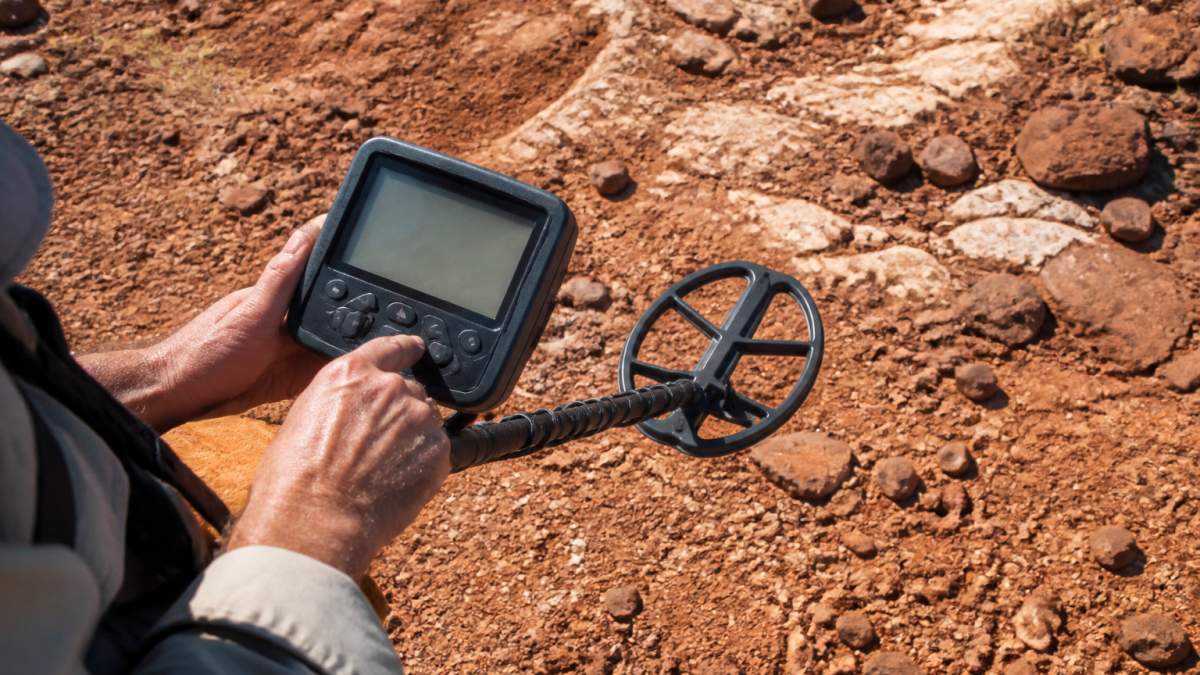
Beginners often assume they should start cheap and upgrade later. A better approach: start with proven equipment that handles your actual soil, learn it properly, and upgrade when you're ready for advanced features.
The Nokta Magnetar 9000 represents the modern standard for Australian prospecting. It's built specifically for harsh mineralized ground with dual-receiver coils that handle both deep nuggets and small flakes.
For budget-conscious beginners, the USED Minelab GPX 6000 at $7,995 offers proven performance. It's lighter than older models, has automatic ground balance that adjusts as you detect, and comes with multiple coils and wireless headphones.

The USED Minelab GPZ 7000 at $7,500 is the deepest detector available, offering 40% more depth than previous generations. For serious nugget hunters, the extra depth justifies the investment.
All three handle mineralized soil effectively. Choose based on budget and whether you prioritize depth (GPZ 7000), balance (GPX 6000), or modern features with future updates (Magnetar 9000).
Ground balancing is the single most important skill in mineralized soil. It's also the most misunderstood. Get this wrong and your detector either ignores real targets or screams at every rock.
Ground balance tells your detector to ignore the electromagnetic signature of your soil. You're essentially saying: "This is what normal ground looks like; ignore it and alert me only to metal." In lightly mineralized soil, this is simple. In Australian goldfields, it's essential. Mastering this calibration allows you to spend more time prospecting and less time troubleshooting, ensuring you remain focused on your hunt until it is time to prepare a meal using reliable camping cooking sets.
Automatic ground balance adjusts continuously as you detect. You turn on the machine and it handles mineralization without intervention. This sounds ideal, but it has limits. Automatic systems work well in moderately mineralized ground but can struggle in severely mineralized areas where soil composition changes rapidly.
Manual ground balance requires you to adjust settings based on soil conditions. You use a calibration process (usually pressing a button while holding the coil above soil) to set a baseline. This takes 30 seconds but gives you precise control. In areas with inconsistent mineralization, manual balancing lets you adjust as you move.
Best practice: start with automatic if your detector offers it. If you're getting false signals or missing targets, switch to manual and fine-tune. Lost Treasures provides training on both methods, contact us online or visit our Everton Park store for instruction.
Sensitivity controls how aggressively your detector responds to targets. Higher sensitivity finds deeper and smaller targets but also picks up more noise. Lower sensitivity reduces false signals but misses weak targets.
The mistake most beginners make is running sensitivity too high. You see the maximum setting and assume it's best. In mineralized ground, maximum sensitivity means maximum ground noise. You'll spend your day digging bottle caps and hot rocks.
Start with sensitivity at 70-80% and adjust downward if you get false signals. In heavily mineralized areas, you might run 50-60% sensitivity and still find gold effectively. The goal isn't the highest setting; it's the highest setting that produces clean, stable audio with minimal noise.
Hot rocks are the curse of Australian prospecting. These are rocks with high iron content that create strong electromagnetic responses, mimicking metal targets. A hot rock can sound identical to a gold nugget.
Hot rocks are unavoidable in mineralized ground, they're part of the environment. The question is how to manage them. Pulse induction detectors handle hot rocks better than VLF because the pulse pattern is less affected by iron mineralization. But even PI detectors respond to severe hot rocks.
When you dig a hot rock, you learn. Each one teaches you the sound signature of your local ground. After 20-30 hot rocks, you start recognizing the difference between a rock and a target. It's tedious, but it's the real skill of prospecting.
False signals (also called false positives) are detector responses to ground noise, not actual targets. They're erratic, unstable, and usually brief. A real target produces a consistent, repeatable signal.
Reduce false signals by:
Budget doesn't determine success; technology choice and soil match do. A $7,500 pulse induction detector in the wrong hands underperforms a $2,000 VLF in ideal conditions.
Under $5,000: Limited options that truly handle harsh mineralization. VLF detectors in this range work in lighter soils but struggle in heavy red earth. Not recommended for serious prospecting in Australian goldfields.
$5,000-$8,000: This is where serious prospecting begins. The Nokta Magnetar 9000 at $7,999 (with $400 deposit), USED Minelab GPX 6000 at $7,995, and USED Minelab GPZ 7000 at $7,500 all deliver proven performance.

Over $8,000: Premium features like advanced GPS mapping, wireless audio, and submersible designs. At this level, you're paying for durability, future-proofing, and specialized capabilities.
For beginners, start with a detector in the $5,000-$8,000 range that matches your soil. Learn it thoroughly. Upgrade when you've outgrown its capabilities, not before.
Finding the right detector transforms prospecting from frustration to reward. Australian soil demands equipment designed for Australian conditions, not imports tuned for overseas geology.
Beginners benefit from detectors with automatic ground balance and simple operation modes. The Nokta Magnetar 9000 features an Easy Mode that requires minimal setup, while the Minelab GPX 6000 includes automatic ground balance and noise cancellation that adjust as you detect. Both handle mineralised soil well. Start with a detector offering wireless audio to reduce fatigue, and consider hiring before purchasing to build confidence with the technology.
When comparing detectors for mineralised soil, prioritise ground balancing capability, noise cancellation channels, and coil technology. Pulse induction detectors like the Magnetar 9000 excel in highly mineralised ground because they ignore mineral content. Check detection depth specifications for your target (small gold vs nuggets), coil size options for your terrain, and whether the detector offers firmware updates. Test in your local soil type if possible before committing.
VLF (Very Low Frequency) detectors transmit continuous signals and struggle in mineralised soil because minerals trigger false signals. Pulse induction (PI) detectors send short, high-energy pulses and ignore mineral ground noise, making them superior for rocky, heavily mineralised terrain. PI detectors typically cost more and require more power, but deliver better depth and stability in challenging conditions. For Australian goldfields with significant mineralisation, PI technology is generally the better choice.
Hot rocks generate false signals in mineralised ground. Reduce them by increasing ground balance precision, manual ground balance lets you fine-tune to your exact soil. Lower sensitivity slightly if false signals persist; this trades some depth for stability. Detectors with multiple noise cancellation channels (like the GPZ 7000's 256 channels) filter out mineral noise automatically. Scan slowly over hot rock areas and learn to distinguish target tones from ground noise through practice.
Comments will be approved before showing up.


