
Your Cart is Empty



Last Updated: October 14, 2026
Metal detecting training for beginners opens up a rewarding hobby that combines outdoor adventure with the thrill of discovery. At Lost Treasures, we guide beginners through their first detecting experience. The biggest mistake many beginners make is jumping straight into the field without basic preparation. You'll waste hours chasing bottle caps and aluminium foil if you don't understand how your detector works and what signals mean.
This guide covers everything you need to start metal detecting with confidence. We'll walk you through choosing your first detector, mastering essential controls, understanding the signals you'll hear, and navigating the legal landscape across Australian states and territories. By the end, you'll have a clear plan for your first day in the field.
Selecting the right detector matters more than most people think. A machine that matches your budget, terrain, and targets will keep you detecting. One that doesn't fit your situation will end up in a cupboard.
New detectorists often ask whether they should spend big money or start cheap. The answer depends on your commitment level and where you'll detect.
Budget options under $300 exist, but they come with real limitations. Entry-level machines struggle in highly mineralised soil, lack depth capability, and offer minimal customisation. You'll hit a frustration ceiling quickly.
The sweet spot for beginners is $400-$600. At this price point, you get reliable performance, decent depth, and enough features to grow into the hobby. The Nokta FindX Pro sits in this range at $419.00.

If you're serious about gold prospecting or plan to detect regularly, investing $1,200 and above opens access to advanced technology. The XP ORX with an 11-inch Elliptical Coil at $1,299.00 offers 23-hour battery life and wireless connectivity.

Not all detector features matter equally when you're learning. Focus on these essentials:
The FindX Pro includes all of these in one package: fully automatic modes, single-menu simplicity, Target ID scale, and a waterproof 11-inch search coil. It's why we recommend it for beginners.
Understanding your detector's controls transforms random beeping into meaningful information. Most beginners skip this step and wonder why they find mostly rubbish.
Ground balance is your detector's ability to ignore the mineral content in soil.
Many beginner machines handle ground balancing automatically. You power on, and the detector reads the soil around you and adjusts internally. This works well in most situations.
Manual ground balancing gives you control. You hold the coil over clean ground, press a button, and the detector learns what "normal" soil sounds like.
Sensitivity controls how deeply your detector searches and how strongly it responds to targets. Higher sensitivity finds deeper targets but also picks up more noise from mineralised soil and nearby metal objects.
Start at 50% sensitivity. Hunt for 30 minutes and listen to the ground noise. If you hear constant chatter, lower sensitivity to 40%.
Discrimination tells your detector which metals to ignore. You set it to reject ferrous metals (iron, nails, bottle caps) and accept non-ferrous targets (gold, copper, silver, jewellery).
Most detectors use a numeric scale (0-99). Zero accepts everything. As you increase the number, you reject more ferrous material.
Start at discrimination 10-15 for general detecting. This rejects obvious rubbish (nails, tin cans) while keeping gold and jewellery. As you learn to recognise signals, adjust gradually.
Target ID shows what your detector thinks it's found. The scale typically runs 0-99, with ranges for ferrous, foil, jewellery, and gold.
Learn to trust the ID number but verify with your eyes. A target ID of 88 might be gold, or it might be a bottle cap with a gold-coloured coating.
The sounds your detector makes carry meaning. Learning to interpret them separates successful detectorists from frustrated ones.
A clear, sharp beep with consistent volume means a solid target at moderate depth. These are usually worth digging.
A faint, warbling beep suggests a small target, deep target, or low-conductivity metal like gold. Don't dismiss these; they often reward digging.
A double beep or stuttering sound usually indicates ferrous metal or mineralised ground.
A silent ground with occasional beeps is ideal. It means your ground balance is correct and your sensitivity is appropriate.
Pinpointing narrows the exact location. Move the coil in an X pattern over the beeping area. The beep gets louder near the target's centre.
Practice in your backyard before heading to a goldfield.
Formal training accelerates your learning curve. Lost Treasures offers comprehensive training for all skill levels, from complete beginners to experienced prospectors refining their technique.
Hands-on courses teach detector operation, signal interpretation, site selection, and recovery techniques. You'll work with experienced instructors in actual detecting conditions, not a classroom.
Books like Coin and Relic Detecting in Australia ($75.00) provide detailed guidance on detector operation, site research, extraction tools, and identifying finds within an Australian context.
![[Book] Coin and Relic Detecting in Australia](https://cdn.shopify.com/s/files/1/1838/1787/products/1_3_12.jpg?v=1682215759)
Online communities connect you with experienced detectorists. Forums and detecting clubs share locations, techniques, and finds. Many areas have regular club meetings where members detect together and share knowledge.
Starting with one or two training sessions prevents costly mistakes and builds confidence faster than trial-and-error.
Legal requirements vary significantly across Australian states and territories. Detecting on the wrong land or without proper permits can result in fines and equipment confiscation.
Each state and territory manages metal detecting differently. Some require permits for any detecting activity. Others allow detecting on public land without permits but restrict certain areas.
Check your state's regulations before your first outing. Contact your local Department of Mines or equivalent authority. They'll clarify what you can and cannot do.
Common restrictions include:
Permit costs typically range from modest annual fees to per-location charges. Some areas offer free permits for recreational detecting. Others charge for commercial prospecting rights.
Heritage-listed sites and Aboriginal cultural heritage areas are protected by law across Australia. Detecting on these lands without explicit permission is illegal, regardless of your intentions.
Aboriginal sites include sacred places, burial grounds, and areas of cultural significance. These are protected under state and territory Aboriginal heritage legislation. Disturbing them carries serious penalties.
Before detecting in unfamiliar areas, research the heritage register for your state. Many state governments maintain online databases showing protected sites. If your intended location falls within a protected area, either obtain written permission or choose a different location.
The consequences of ignoring heritage protection laws extend beyond fines. You risk damaging irreplaceable cultural material and harming relationships between the detecting community and Indigenous peoples.
Research transforms a random walk into a targeted hunt. Successful detectorists spend hours planning before heading to the field.
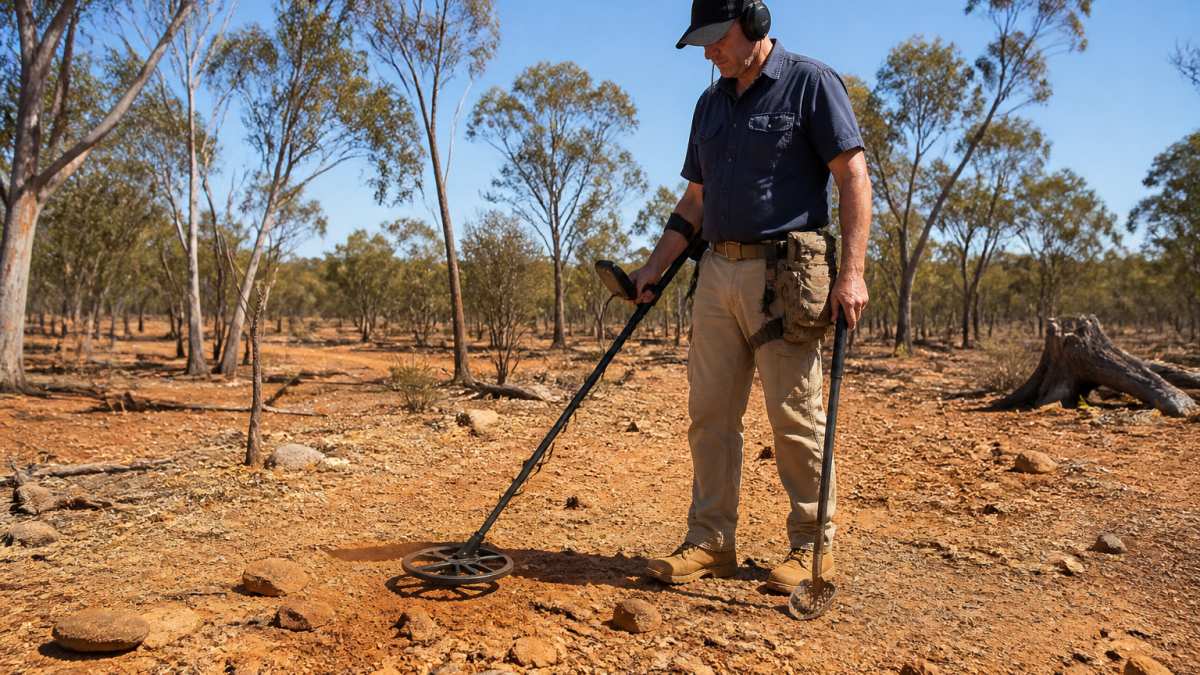
Start with historical records. Old mining records, newspaper archives, and historical societies document where gold and silver were found.
Topographic maps show terrain features. Creeks, gullies, and ridges concentrate targets. Water movement carries gold downslope, so creek beds and benches often reward detecting.
Talk to local detecting clubs. Members know productive areas, current conditions, and permit requirements. They'll point you toward realistic first locations rather than exhausted hotspots.
Visit your chosen location during daylight first. Walk the ground, assess terrain difficulty, and identify hazards.
Permission is non-negotiable. Contact landowners weeks in advance. Explain what you're doing, where you'll detect, and how long you'll stay.
Digging efficiently protects the ground and your finds. Careless digging damages soil structure and harms future detecting in that area.
Use a proper digger tool. The Nokta Standard Digger with Belt Holster ($35.00) is designed for sandy soil and beach detecting.
When your detector signals a target, pinpoint it precisely. Mark the spot with a stick or flag.
As you dig, recheck the hole with your detector. The target might be deeper than expected, or you might have missed it on the first pass.
Once you've recovered the target, fill the hole completely. Refill with original soil and compact gently. Leaving holes unfilled damages the ground and frustrates landowners.
Carry a small pouch for finds. This keeps targets safe and your hands free for detecting.
Most beginners repeat the same errors. Awareness prevents frustration.
Metal detecting training for beginners requires patience, proper equipment, and respect for local regulations. Lost Treasures supports your journey with top-tier equipment like the FindX Pro, comprehensive training programs, and expert guidance every step of the way.
The Nokta FindX Pro is specifically designed for beginners, with automatic search modes for Field, Park, Jewelry, and Beach detecting. It has a turn-on-and-go design and simple single menu interface, so you're not overwhelmed by settings. At $419, it includes everything you need: waterproof coil, headphones, digger, and carrying bag. The rechargeable battery lasts 12 hours, letting you detect all day without constant battery replacements.
Australian red soil and mineralised ground require detectors with adjustable ground balance. The Nokta FindX Pro and XP ORX both feature automatic ground balancing, which compensates for soil mineralisation that can cause false signals. Before buying, check the detector's ground balance capability and read reviews from local detectorists. Many detectors sold in Australia are specifically tested in local conditions, and hiring first lets you test performance in your actual detecting area.
Permit requirements vary by state and territory. Most states require permission from the landowner and may require a fossicking licence for public land. Some areas prohibit detecting on heritage-listed land and Aboriginal sites. Check your state's Department of Resources or equivalent body for current rules. Always research before you go, get written permission, and avoid restricted areas. Responsible detecting protects the hobby for everyone.
Most beginners do find rubbish initially, but learning signal interpretation speeds up your success. Modern detectors like the FindX Pro have target ID scales that help you identify what's underground before you dig. Start in areas with known targets (old campsites, goldfields, beaches), use discrimination settings to ignore iron rubbish, and practice in a quiet location first. Within a few outings, you'll distinguish bottle caps from coins and genuine targets from trash.
Comments will be approved before showing up.


