
Your Cart is Empty



Last Updated: October 12, 2026
Finding the right metal detector for fossicking can feel overwhelming, with dozens of models at wildly different price points. What matters is matching the detector to your budget, experience level, and the ground conditions where you'll actually be searching.
We've worked with thousands of prospectors across the goldfields. Some buy expensive machines and never use them; others find gold with entry-level gear because they picked the right technology for their environment.
The best metal detectors for fossicking fall into a few clear categories: beginner-friendly machines, pulse induction detectors for heavily mineralised ground, VLF machines that balance sensitivity and ease of use, and professional rigs that cost serious money but find deep nuggets others miss.
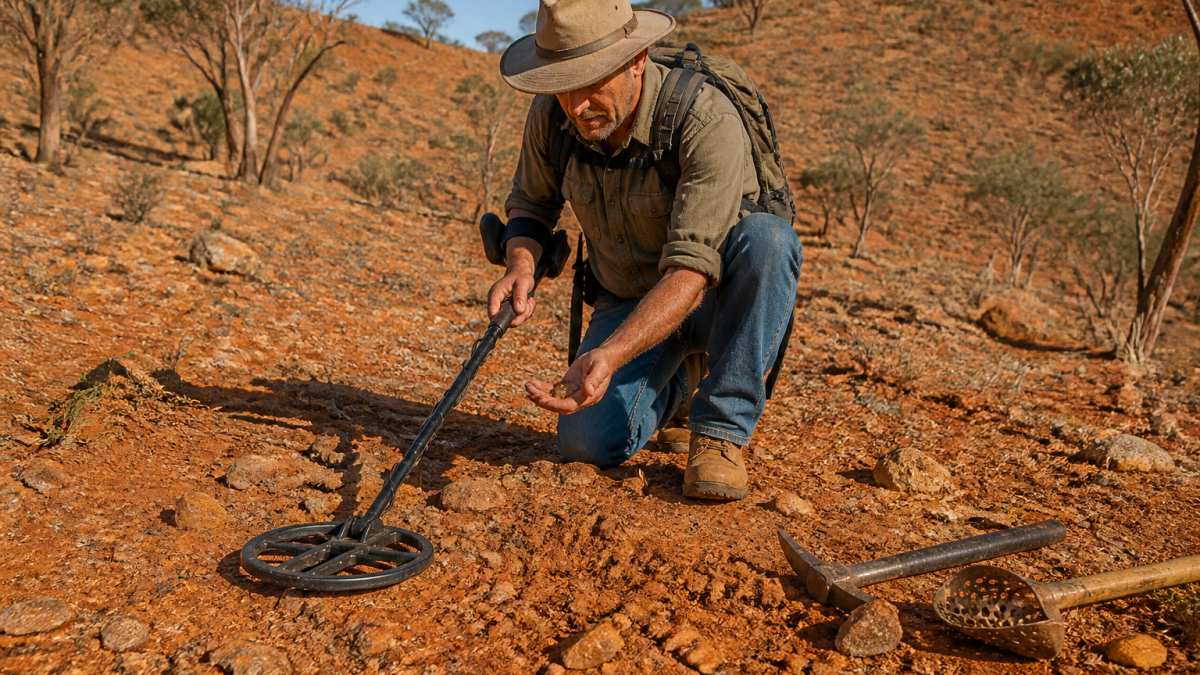
What separates a good detector choice from a wasteful one comes down to three things: ground balance performance in your local soil, detection depth for the size of gold you're targeting, and whether the learning curve keeps you in the field.
| Detector | Technology | Best For | Starting Price |
|---|---|---|---|
| Nokta FindX Pro | VLF (15 kHz) | Complete beginners | $419 |
| Nokta Double Score | Simultaneous Multi-Frequency | Budget-conscious prospectors | $749 |
| The Legend 2 | Simultaneous Multi-Frequency | All-terrain hunters | $1,480 |
| Garrett Vortex VX9 | Multi-Dimensional Multi-Frequency | Beach and wet sand | $1,299 |
| XP ORX | High-Frequency (21 frequencies) | Gold and coin hunters | $1,299 |
| USED Minelab SDC 2300 | Pulse Induction | Small gold specialists | $3,400 |
| USED Minelab GPX 6000 | Pulse Induction | All-size gold detection | $7,995 |
| USED Minelab GPZ 7000 | Pulse Induction | Deep nugget hunting | $7,500 |
| Nokta Magnetar 9000 | Advanced Pulse Induction | Harsh mineralized ground | $7,999 |
We didn't rank detectors by brand popularity or marketing hype, but on real-world performance in Australian goldfields and the needs of fossickers at different stages.

Our criteria included ground balance stability in heavily mineralised soil, detection depth relative to coil size, sensitivity to small flakes and larger nuggets, battery life, weight and ergonomics, and waterproofing. We also weighted the learning curve heavily: a detector you're too frustrated to use is worthless, no matter how advanced.
We included both new and quality used machines because a second-hand professional detector often outperforms a new entry-level model. Used Minelab units represent exceptional value if you're willing to learn their more complex interface.

The Nokta FindX Pro exists to get you detecting without overwhelm. At $419, it's a low barrier to entry among quality machines, and it genuinely works.
This detector uses 15 kHz VLF technology, so it struggles in heavily mineralised red soil compared to pulse induction alternatives, but on cleaner ground it finds gold. The turn-on-and-go design means you select Field, Park, Beach, or Jewelry mode and the detector handles ground balance automatically, with no menus, frequency shifting, or threshold tuning.
The package includes a waterproof search coil, headphones, a premium digger, and a carrying bag. Battery life runs 12 hours via USB, and the detector is fully submersible to 5 metres for creek work.
What holds it back: VLF detectors lose sensitivity in the red, iron-rich soil common across Australian goldfields, so you'll outgrow this machine fast if you hunt heavily mineralised ground. It also struggles to distinguish hot rocks from genuine targets in noisy ground, meaning more false digs.
The FindX Pro makes sense as a trial run: if you decide fossicking isn't for you, you've only spent $419; if you love it, you'll know exactly what features you need in an upgrade.
The answer depends entirely on your ground.
VLF (Very Low Frequency) detectors operate at fixed, low frequencies, typically 5 to 18 kHz. They excel at finding small targets like coins, jewellery, and fine gold flakes. They're lightweight, affordable, and simple to operate. The Nokta FindX Pro and The Legend 2 both use VLF or multi-frequency technology that includes VLF modes.
The catch: VLF detectors struggle in mineralised ground, where iron minerals create electrical noise the detector interprets as targets, so you dig more holes for nothing. In heavily mineralised Australian goldfields, a VLF detector becomes frustrating quickly.
Pulse Induction (PI) detectors send short pulses of electrical energy into the ground and listen for the reflected signal, an approach far less affected by mineralisation. The USED Minelab SDC 2300, USED Minelab GPX 6000, USED Minelab GPZ 7000, and the new Nokta Magnetar 9000 are all pulse induction machines.

PI detectors find larger nuggets and detect deeper, but they're noisier to operate, have shorter battery life, are heavier, and cost significantly more.
For Australian fossicking, the ground conditions determine the choice. Clean alluvial areas with light mineralisation? VLF works fine. Heavily mineralised goldfields with red soil and ironstone? Pulse induction is essential.
Minelab dominates Australian gold detecting because their pulse induction technology is proven across decades of field use, and their machines hold value because they work.
The USED Minelab SDC 2300 at $3,400 is the entry point to serious PI detecting. This folding detector compacts without disassembly, is waterproof to 3 metres, and includes a lithium battery, spare rechargeable cells, charging dock, headphones, and accessories.
The SDC 2300 excels at finding small gold in all terrains, with Automatic Ground Tracking and Noise Cancel keeping performance stable in tough conditions. For prospectors wanting their first serious PI detector, this is the logical choice.
The USED Minelab GPX 6000 at $7,995 steps up significantly, featuring GeoSense-PI technology for real-time ground analysis and high sensitivity to everything from sub-gram gold to large, deep nuggets.
The GPX 6000 is a workhorse for experienced prospectors, handling small and large targets, detecting deeper than the SDC 2300, and maintaining stability in the harshest mineralised soils.
The USED Minelab GPZ 7000 at $7,500 is the specialist's choice, offering up to 40 per cent more depth than previous GPX Series detectors. The Super-D coil is highly sensitive to gold of all sizes, and 256 Noise Cancel channels maintain smooth performance in extremely tough conditions.
The GPZ 7000 is a specialist's choice, offering up to 40 per cent more depth than previous GPX Series detectors.
The detector is just the start. Successful fossicking requires supporting gear that keeps you comfortable and productive.
Search coils matter more than people realise. A larger coil covers ground faster but struggles in tight spaces and dense vegetation, while a smaller coil is slower but precise around rocks and trees.
Headphones need to be reliable and comfortable for hours of wear. Wireless options reduce cable snags, and low-latency Bluetooth (like the aptX headphones included with The Legend 2) ensures you hear target response without delay.
Digging tools vary by ground type: hard, rocky soil requires a heavy pick, while soft alluvial ground works better with a spade or small shovel. Most quality detectors include a digger, but upgrading to a proper fossicking spade saves your back over long sessions.
Batteries and chargers determine how long you stay in the field. Lithium batteries (included with most modern detectors) last 10-23 hours depending on the model, and carrying a spare or an external charger extends your day.
Protective gear includes gloves for rocky ground, sun protection, and sturdy boots with ankle support, since fossicking often means walking uneven terrain carrying a detector.
Storage and transport matter if you're driving to remote goldfields. A quality detector bag protects your investment and keeps coils from tangling; hard cases suit serious prospectors, padded backpacks casual hunters.
Before you take any detector into the field, understand the legal landscape. Fossicking laws vary significantly across Australian states and territories.
In most states, fossicking is permitted on public land under specific conditions. You typically need a fossicking licence or permit, which costs little but is mandatory. Queensland Department of Resources fossicking guidelines outlines the rules for that state. New South Wales mining regulations for fossickers covers NSW. Each state's resources or mines department publishes current rules.
General restrictions apply across all jurisdictions:
Check your specific state's current regulations before heading out, as rules change and ignorance of a permit requirement can result in fines.
Lost Treasures can advise on local rules for your area and point you toward relevant permits and approved goldfields.
Most beginners make one of three critical errors when selecting their first detector.
Mistake 1: Buying based on price alone. A $300 detector from an online marketplace often lacks the ground balance and noise rejection needed for Australian soil, leaving you frustrated and digging endless false targets. The $419 Nokta FindX Pro performs genuinely.
Mistake 2: Ignoring ground conditions. Buying a VLF detector for heavily mineralised red soil sets you up for failure, as the detector will constantly false signal and you'll blame the machine rather than the mismatch between technology and terrain.
Mistake 3: Underestimating the learning curve. Advanced detectors like the USED Minelab GPX 6000 are powerful but complex, and beginners often get overwhelmed by settings and modes and never master the machine.
A fourth mistake: not getting training. Many people buy a detector, read the manual, and head out, missing easy optimisations and wasting time chasing noise instead of targets. Lost Treasures offers comprehensive training for all skill levels, and a few hours of guided instruction accelerates your learning curve dramatically.
Choosing the best metal detector for fossicking means matching technology to your ground, your budget, and your commitment level.
Pulse induction (PI) detectors emit short bursts of electrical energy and excel in highly mineralised ground, making them ideal for Australian goldfields. They detect small nuggets and deep targets reliably. VLF (very low frequency) detectors use continuous wave transmission and are lighter, more affordable, and better for beginners, but struggle in red soil and iron-rich areas. For fossicking in challenging terrain, PI technology typically outperforms VLF.
Budget detectors like the Nokta FindX Pro ($419) work well for beginners learning the hobby, but they sacrifice depth and sensitivity in heavily mineralised ground. If you're fossicking in typical Australian goldfield soil, investing in a mid-range detector can deliver better target response and fewer false signals. Budget models are excellent for testing commitment before spending more.
Start at $419-$750 if you're a complete beginner testing the hobby. Mid-range options ($1,200-$1,500) suit most recreational fossickers and handle mineralized ground well. Serious prospectors targeting deep nuggets invest $3,400-$7,995 in pulse induction machines like the Minelab GPX 6000 or GPZ 7000. Total cost of ownership includes coils, batteries, headphones, and maintenance.
Fossicking rights vary by state and territory. Most regions allow small-scale, non-commercial gold panning and metal detecting on Crown land and designated fossicking areas without a permit. Check your local Department of Resources or equivalent authority for specific regulations, prohibited zones, and any required permissions. Private land requires explicit owner consent. Always verify current rules before heading out, as restrictions can change.
Comments will be approved before showing up.


