
Your Cart is Empty



Quick Summary
The best rocky ground pinpointer for Australian terrain is usually a pulse induction unit, because PI pinpointers ignore the fast-decaying response of ironstone and magnetite that makes VLF models chatter. VLF pinpointers suit mild ground and small shallow nuggets, while sealed housings and replaceable probe sleeves handle wear from rock.
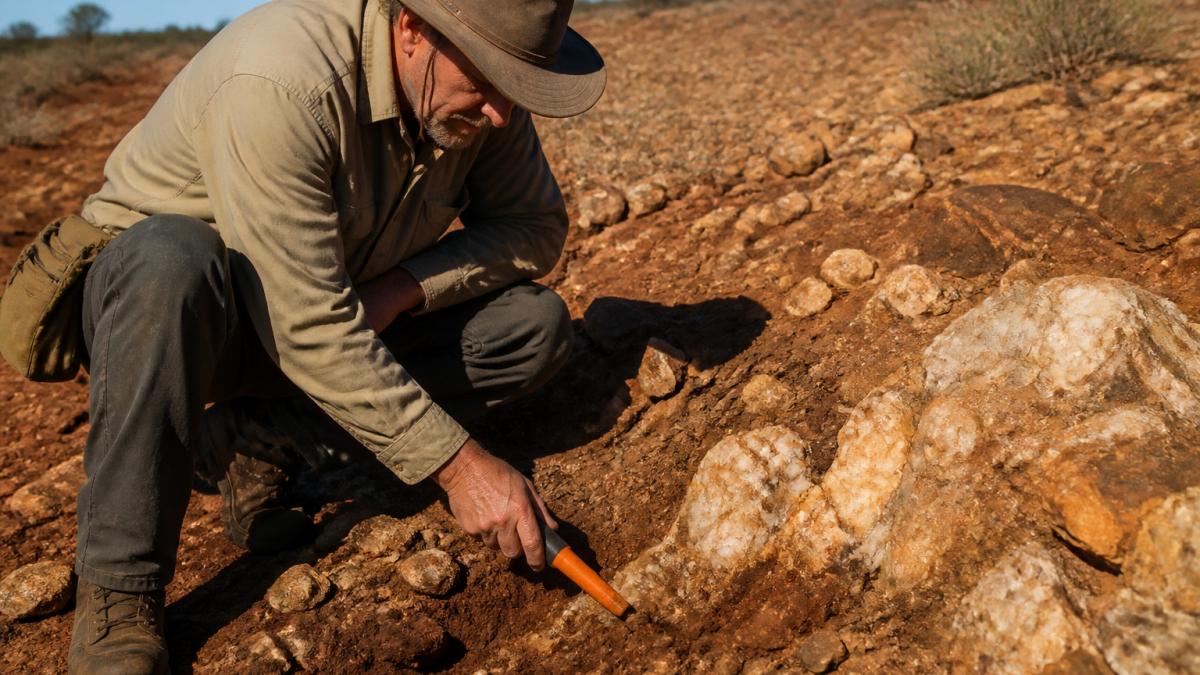
Rocky ground is where most pinpointers struggle first, and a good rocky ground pinpointer has to handle it. Quartz, ironstone and mineralised gravel send false signals back to the coil, and a tool that sings on a clean creek bed can chatter all afternoon on a rocky hillside. Before you buy, it helps to know exactly why.
Mineralisation is the main culprit. Much of the ground across the Australian goldfields carries iron oxides and magnetite that react to the detector's field. The result is a constant background hum that masks small, real targets. A pinpointer that cannot be ground balanced or tuned for sensitivity will often mask the very nugget you are hunting.
Physical wear matters just as much. Probes get knocked against rock, dropped in gullies and dragged through gravel. A housing that is only splash-resistant may not survive a season of this. Our advice is to look for a sealed housing, a replaceable probe sleeve and a tip that does not flex under pressure, the way you would with any rocky ground pinpointer.
Pulse induction (PI) and very low frequency (VLF) pinpointers generate and process their electromagnetic fields in different ways. Understanding the mechanism is more useful than memorising a feature list.
A VLF pinpointer transmits a continuous sine wave and measures the phase shift caused by a target. That makes it very sensitive to small, shallow nuggets and good at discriminating ferrous from non-ferrous metal. The weakness is that ironstone, magnetite and conductive salt all shift the phase too. In heavily mineralised ground the pinpointer cannot separate the ground signal from the target signal, so it either chatters constantly or has to be detuned until small nuggets disappear. Most VLF pinpointers offer manual sensitivity or a ground-balance trim, but on hot ground you are always trading depth for stability.
A PI pinpointer pulses the coil on and off and samples the decay curve after each pulse. Ironstone and magnetite decay very quickly, so the pinpointer can time its sample to ignore most of the ground response. That is why PI units stay quiet and keep their depth on ground where a VLF unit is unusable. The trade-offs are real: PI pinpointers generally cost more, draw more current, and most cannot discriminate ferrous from non-ferrous, so you dig more rubbish. They are also less sensitive to very small, thin nuggets than a well-tuned VLF unit on clean ground.
For rocky ground the practical rule is this: if your detector is already struggling with hot rocks, a VLF pinpointer will struggle too. If your ground is mild and you are chasing small, shallow pieces, a VLF pinpointer gives you more target information for less money.
We have listed the pinpointers we stock that suit rocky ground, with the current price in AUD for each. Compare the detail below against the terrain you actually work.
| Pinpointer | Price (AUD) | Technology | Best For |
|---|---|---|---|
| XP MI-6 | $299.00 | Pinpointer | Serious prospectors on mixed ground |
| XP MI-4 | $259.00 | Pinpointer | Value-focused prospectors |
| Nokta Pulsedive Scuba and Pointer | $319.00 | Pulse induction, 2-in-1 | Wet and beach use plus land |
| Nokta Pointer | $159.00 | Pinpointer | Budget entry, general use |
| Ex Demo Nokta AccuPOINT | $209.00 | Pinpointer | Lightly used, $40 off RRP |
The XP MI-6 is a pinpointer priced at $299.00, placing it at the premium end of our range. It suits people who expect to use a pinpointer hard and often.

The MI-4 is a pinpointer priced at $259.00, a lower-priced option than the MI-6.
The Pulsedive is a two-piece kit: a scuba detector and a matching pinpointer, priced at $319.00. You can see the full Pulsedive kit and its specifications on its product page. It is the choice for people who split their time between land and water. The pinpointer is rated waterproof to 60 metres.

At $159.00, the Nokta Pointer is fully submersible, runs for more than 30 hours on a 9V alkaline battery, and comes with replaceable probe sleeves. Sensitivity is manually adjustable. Best for: budget-minded prospectors.

The AccuPOINT is a lightly used demonstration unit, now $209.00 after a $40 reduction from RRP. It is a used-once demonstration unit with a colour display.
Mineralised ground does not just make a pinpointer noisy, it changes the shape of the signal you are reading. For a deeper look at detecting in red Australian soil, see our complete guide. Learning to tell a hot rock from a nugget is the single biggest time-saver in rocky terrain, and most guides skip it entirely.
Start by characterising the ground before you dig. Sweep the pinpointer over a patch of bare soil away from your target and listen to the background. A steady low hum is normal in mineralised ground; a sharp chirp on every stone means the sensitivity is too high or the pinpointer needs a ground-balance trim. On a VLF unit, drop sensitivity in small steps until the chatter settles. On a PI unit, most of the ground response is already filtered out, so if you are still getting constant signals, check that the probe is not touching the soil, PI pinpointers will sound off on contact with conductive ground.
Once the background is stable, approach the target in short arcs and lift the probe slightly between passes. A nugget gives a sharp, narrow response that grows stronger as the tip closes in. A hot rock or mineral cluster gives a broad, flat response that stays roughly the same strength across several centimetres and often fades when you lift the probe. If the signal is wide and dull, scrape a little soil away and re-check before you dig a full hole, many hot-rock signals disappear once the surface layer is broken.
In high-iron ground, use the pinpointer's discrimination or iron-reject mode if it has one, but understand the cost. Rejecting iron also rejects small, deep or oddly shaped gold, and in rocky ground the reject threshold is rarely clean. A common pattern among experienced prospectors is to run with discrimination off, dig the broad signals once to confirm they are hot rocks, and then trust the sharp signals for the rest of the session.
Watch out: do not crank sensitivity to maximum to compensate for a small target in hot ground. The pinpointer will report every mineralised stone within range, and you will spend the afternoon digging basalt instead of gold.
Rocky ground punishes equipment, so a few habits make a real difference:
These small steps cost nothing, but they extend the working life of any pinpointer on rough ground.
Match the tool to the ground you actually hunt. If the soil is clean and you are new to the hobby, the Nokta Pointer at $159.00 gives you a solid start. If you prospect hard, mineralised country every weekend, the XP MI-6 at $299.00 is the better long-term investment. Hunting mixed land and water points you toward the Nokta Pulsedive at $319.00.
Not sure which fits your ground? Our team can help you choose. Use our enquiry form to tell us where you hunt and what you find, and we will recommend the pinpointer that suits that terrain.
The Nokta Pointer has replaceable probe sleeves, so you can swap out worn material instead of replacing the whole unit. Check whether the probe surface can be replaced before you buy, and keep the tip clean of grit after each session to slow wear.
Yes, if you work in wet creek beds or dig in damp gravel. The Nokta Pointer is rated waterproof to 1 m, and the Nokta Pulsedive Scuba Detector and Pointer is rated waterproof to 60 m. Pick a model that matches the depth you will actually work in, and rinse it with fresh water after salty or muddy sessions to protect the housing and battery contacts.
VLF pinpointers use a continuous low-frequency signal and tend to give stronger discrimination, while pulse induction models ignore most ground mineralisation and are generally better in highly mineralised soil. The Nokta Pulsedive uses pulse induction at 3 kHz with a frequency shift function. Test any model on your own ground before committing.
Lower the sensitivity setting until the unit stops chattering over bare ground, then raise it slowly until you get a clear, steady response to a test target. The Nokta Pointer has manual sensitivity adjustment. Moving the probe slowly and keeping it parallel to the ground also reduces ground noise and makes real targets easier to separate.
Comments will be approved before showing up.


