
Your Cart is Empty



Last Updated: October 26, 2026
Quick Summary
The top five wet sand accessories are a sand scoop, a waterproof pinpointer, a submersible DD coil and cover, waterproof headphones, and a mesh finds pouch. These wet sand accessories handle salt false signals, collapsed holes, surf noise and corrosion. Our top pick is the Detect-Ed V2 Beach Scoop at $299.00.
Wet sand is the most punishing environment a detectorist will ever work in, and the top five wet sand accessories exist because of one simple fact: saltwater conducts electricity.
Wet sand detecting is the practice of recovering targets from saturated, salt-soaked ground where standard coils, scoops and pouches stop performing as designed. Saturated sand collapses into every hole you dig, salt minerals trigger constant false signals, and salt spray quietly eats aluminium and steel fittings between trips.
Three things break on a wet beach, in this order.
The good news: the fix is a short list of gear, not a new detector.
We picked these five on four criteria: does it shed wet sand, does it survive saltwater, does it fit common detectors, and does it earn its price. Every item below is stocked by Lost Treasures and listed at its current price in Australian dollars.
| Accessory | Price (AUD) | Job on Wet Sand | Best For |
|---|---|---|---|
| Detect-Ed V2 Beach Scoop | $299.00 | Target recovery | Most beach hunters |
| Waterproof pinpointer | Varies by model | Locating in the hole | Faster recovery |
| Submersible DD coil and cover | $335.00 / $30.00 | Salt handling, depth | Mineralised beaches |
| Waterproof headphones | $289.00 - $419.00 | Clear audio in surf | Shallow water |
| Mesh finds pouch | $29.00 - $75.00 | Carrying finds | Everyone |
Here is the shortlist in detail.
Our top pick is the Detect-Ed V2 Beach Scoop with Handle at $299.00, because a scoop is the one accessory that decides whether wet sand detecting is enjoyable or exhausting.

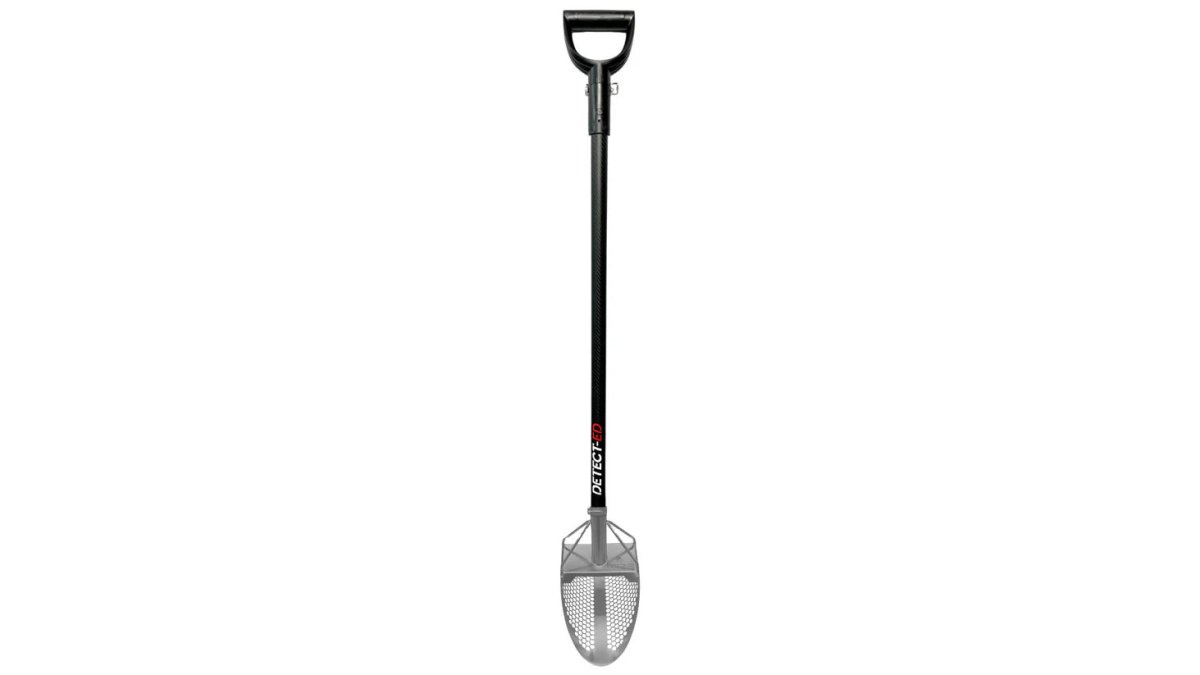
The V2 measures 320 x 180 x 100mm with 10mm hex holes, 2mm steel, and an 850mm pole. It weighs 1.75kg with the handle, 1.25kg for the scoop alone.
If you want a second wet-sand option to weigh up, the Nokta Premium Sand Scoop 3-in-1 Set costs $289.00 in stainless steel with a two-piece handle and three-way adjustable angle.

Stainless steel wins on durability and loses on weight. Plastic is lighter but flexes under load, and cheap plastic baskets can crack at the throat where the handle meets the basket, the highest-stress point on any scoop.
Hole size is the real decision. Too small and wet sand clogs; too large and small targets slip through. A 10mm hole is a sensible middle ground for coins, rings and pull tabs.
Handle length is the other trade-off. A long handle (around 850mm, as on the V2) saves your back and lets you work standing in the surf zone; a short handle packs better but forces you to kneel, which is slower and wetter.
Watch out: a scoop with holes under about 8mm will clog in compact wet sand and you'll spend the session shaking it instead of detecting. Rinse the scoop in freshwater after every saltwater session and dry the handle joint, because salt trapped in the joint accelerates corrosion even on stainless hardware.
A handheld probe can locate a target inside the hole after the scoop has lifted it out. This can be a significant time-saver on a wet beach, because saturated holes collapse and re-scanning with the main coil can waste minutes on every find.
Look for a genuinely waterproof rating rather than water-resistant, a loud speaker or vibration alert for surf noise, and a lanyard point so it doesn't disappear in the wash.
"Waterproof" and "water-resistant" are not interchangeable, and the difference matters once you are kneeling in the surf zone. A water-resistant pinpointer is built to survive splashes and rain; a waterproof one is sealed to be submerged, usually to a stated depth. Check the stated depth rating on the spec sheet rather than the marketing headline, and check whether the rating applies to the whole unit or only the probe tip.
A pinpointer rated to at least a few metres can be beneficial for beach work, as a dropped unit in the wash or a wave over the hole can be a routine event. It is also advisable to check the battery compartment seal, as that is a common point of water ingress on any pinpointer, and a worn O-ring can be a culprit.
Detect-Ed V2 Beach Scoop with Handle →
Pinpointers are largely detector-agnostic, which is one of their advantages: most work as standalone probes and do not need to pair with your detector. The compatibility questions that do matter are physical ones, does it fit a belt holster, does the lanyard attach securely, and is the probe tip narrow enough to fit inside the hole a scoop leaves. A pinpointer with a wide tip can be harder to insert into a collapsed wet-sand hole than a slim one.
Watch out: rinse the pinpointer in freshwater after each saltwater session, dry the battery compartment, and check the O-ring seal before the season starts. Salt residue around a seal is the quiet cause of most pinpointer failures.
Saltwater metal detecting equipment lives or dies on coil choice. A Double-D coil cancels much of the salt response that overwhelms concentric coils, which is why DD is the standard for beach work.
The Garrett AT 8.5" x 11" PROformance DD Searchcoil at $335.00 is fully submersible and built for mineralised ground and saltwater beaches, with strong depth and target separation. Pair it with a Garrett 5" x 8" DD Coil Cover at $30.00.
Watch out: a worn coil cover lets saltwater reach the coil face. Replace it before it splits, not after.
Waterproof headphones matter more in the surf zone than anywhere else, because waves drown out speaker audio and you start missing deep, faint targets.
Two options we stock, matched to different detectors:
Watch out: the ONYX set must run at volume level 1 in bone conduction mode on the DEUS II. Higher volumes can damage your hearing.

A finds pouch sounds trivial until your first wet session, when a sealed bag turns into a bucket of slurry and your best find floats out of an open pocket.
The REEDS Beach Finds Pouch at $29.00 has a mesh base that lets water and sand sift through while both pockets zip shut. The Garrett All Terrain Finds pouch at $75.00 adds mesh drains, a pinpointer holster, an interior carabiner for rings, and two zippered pockets to separate treasure from trash.
Run the same sequence every target and wet sand stops being chaotic.
Then handle corrosion. Freshwater rinse every metal part after each saltwater session, dry the coil cable and connectors, and store gear with the coil cover off so trapped salt can't sit against the coil face. As Parks Victoria guidance on fossicking and public land notes, check local rules before you dig on any public foreshore.
Batteries deserve a mention too: cold, wet conditions drain them faster, so carry a spare set and keep it dry.
The core wet sand accessories are a long-handled sand scoop, a waterproof pinpointer, waterproof headphones, a mesh-bottomed finds pouch and a coil cover. A scoop with 10mm to 11mm holes sifts saturated sand fast, while a waterproof pinpointer narrows down the target once it is out of the hole. A drainable pouch keeps finds secure without carrying half the beach home, and a coil cover protects your search coil from abrasive wet sand.
Stainless steel scoops with laser-cut holes and a long handle work best in wet sand. The Detect-Ed V2 Beach Scoop measures 320 x 180 x 100mm with 10mm hex holes and a 850mm pole, so you can dig and sift without bending. The Nokta Premium Sand Scoop 3-in-1 Set offers a 23cm opening, a two-piece handle and three adjustable angles for transport. Both are built to handle compact, waterlogged sand that plastic scoops struggle with.
A waterproof pinpointer can save time in wet sand. Targets can shift as water fills the hole, and a waterproof pinpointer can allow you to search the spoil pile and the hole itself without worrying about splashes or shallow submersion. It can also reduce the size of the hole you dig, which matters in the surf zone where holes collapse quickly. It is advisable to check the waterproof rating before buying and rinse the unit in fresh water after each saltwater session.
Rinse every item in fresh water after each beach session, dry it fully before storage and pay attention to connectors, coil cables and headphone jacks where salt crystallises. A coil cover protects the search coil from abrasion and keeps salt out of the seams. Store gear with the battery removed or charged as the manufacturer advises, and check O-rings on waterproof headphones and pinpointers regularly. Small habits like these extend the working life of saltwater metal detecting equipment considerably.
Switch to a beach or saltwater mode, lower sensitivity until the detector runs stable, and use ground balance or tracking to handle changing mineralisation. A double-D search coil, such as the Garrett AT 8.5 x 11 inch PROformance DD, minimises the effect of saltwater and heavily mineralised ground. Sweep slowly and keep the coil at a consistent height above the sand. If chatter continues, reduce sensitivity further rather than dismissing the signals as noise.
Wet sand rewards preparation and punishes shortcuts, and the difference between a frustrating session and a productive one usually comes down to five items. If you'd rather test gear before committing, Lost Treasures offers detector hire, training for all skill levels, and a full accessories range with Afterpay, Zip and Humm available. Get started with Lost Treasures and build a wet-sand kit that works the first time the tide turns.
Comments will be approved before showing up.


