
Your Cart is Empty



Quick Summary
The best gold prospecting books and maps for beginners match your chosen method. For hand methods, Gold Fever; The Art of Panning and Sluicing at $30.00 is the most straightforward starting point. Check land status before any trip, because a map that looks current may not show access.
Last Updated: November 5, 2026
Choosing gold prospecting books and maps as a beginner is harder than it looks. Lost Treasures stocks many titles, and the right one depends on how you plan to hunt. Most beginners buy the most popular book, read half of it, and then wonder why they cannot find anything. A better approach is to pick one method first, then choose the reading that supports it.
Beginners often arrive wanting a single guide to cover everything. That rarely works. Gold prospecting covers panning, sluicing, drywashing and metal detecting, and each one asks for different skills and different knowledge of ground. A beginner needs a focused starting point, not a library.
Gold prospecting is the search for gold in creeks, gravels and old diggings using hand methods or metal detectors. A useful beginner resource explains how to find likely ground, how to recover the gold, and how to stay on the right side of the rules.
Watch out: A map that looks current may not show land access. Always check land status before you travel, not after.
The sections below match books and maps to each method, explain how to read a fossicking map, and set out the checks worth making before you head out.
The first decision is your method, because the best book follows from it. A panner needs different reading from a metal detectorist, and a drywasher needs different reading again. Work out which of these you will use in your first few months, then use the comparison below to shortlist rather than buying the most popular title on the shelf.
Gold Fever; The Art of Panning and Sluicing ($30.00) is the most straightforward starting point for hand methods. It covers panning and sluicing technique, classifying material and working a creek. Its strength is that it assumes no prior knowledge; its limitation is that it says little about detector work or regional geology. Best use case: a complete beginner who has bought a pan and a sluice box and wants a single technique reference.
Gold Panning Like a Pro - DVD ($24.00) suits people who learn by watching rather than reading. It shows the sequence step by step, including how to classify material and collect fine gold. Its limitation is that a video is harder to skim in the field than a book. Best use case: pairing with a written guide so you can watch the technique once and refer to the book at the creek.
Gold Rush! the Young Prospectors Guide to Striking it Rich ($35.00) is written for younger family members but gives adults a simple reference too. Its limitation is that it is not a deep technical manual. Best use case: a family starting together, or an adult who wants the absolute basics explained plainly before buying a more detailed title.
Metal Detecting for Gold ($130.00) is the most detailed option here. It suits someone who has already bought a detector and wants to get the most from it, covering target response and ground reading in more depth than a general guide. Its limitation is price and assumed prior knowledge. Best use case: a detector owner who has already committed to the hobby and wants one thorough reference rather than several thin ones.
Site reading for Gold and Silver ($45.00) is a shorter read on reading ground before you dig. It covers how to assess a site and target it more effectively. Its limitation is that it is about site selection rather than machine settings. Best use case: a beginner who wants to learn where to detect before spending on a machine-specific title.
Drywashing For Gold (BOOK) ($30.00) covers that method specifically, which matters because drywashing asks for different ground conditions and different equipment from wet panning. Its limitation is that it is method-specific rather than a general introduction. Best use case: anyone working dry ground who has already settled on that method.
Gold Atlas VIC ($125.00), a Doug Stone Publication, is a regional atlas rather than a teaching book. Its strength is coverage of Victorian ground; its limitation is that it will not teach you technique. Best use case: pairing with a technique book once you have chosen your region.
The Tooloom Gold Rush Book ($40.00) is a historical reference. Its strength is background on old workings; its limitation is that history alone does not tell you whether ground is accessible or productive today. Best use case: reading before you travel to understand what was worked and why.
The table below compares the books covered in this section by method, price and best use case, so you can shortlist quickly.
| Book | Price | Best for |
|---|---|---|
| Gold Fever; The Art of Panning and Sluicing | $30.00 | Complete beginner with a pan and sluice box |
| Gold Panning Like a Pro - DVD | $24.00 | Learning technique by watching |
| Gold Rush! the Young Prospectors Guide | $35.00 | Families starting together |
| Metal Detecting for Gold | $130.00 | Existing detector owners wanting depth |
| Site reading for Gold and Silver | $45.00 | Learning where to detect |
| Drywashing For Gold (BOOK) | $30.00 | Dry ground and drywashing |
| Gold Atlas VIC | $125.00 | Regional coverage of Victoria |
| Tooloom Gold Rush Book | $40.00 | Historical background on old workings |
A map is only useful if you can read it. Start by checking the scale. A map covering a large region shows roads and rivers but little detail, while a large-scale map shows individual gullies and workings. For beginners, a mid-scale map that shows both the terrain and the old diggings tends to be most practical.
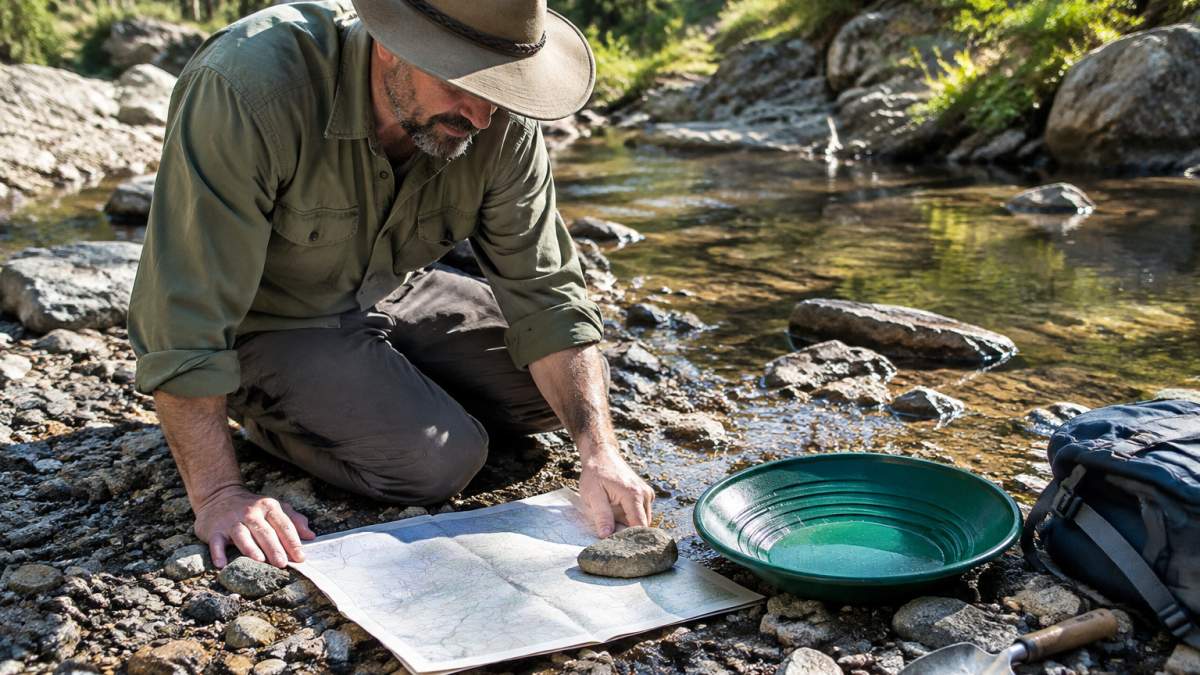
Look for these features when you read a map:
Map symbols vary between publishers, so check the legend before you rely on any marking. A printed map may also be out of date, so treat it as a starting point rather than a guarantee.
The Gold Atlas VIC ($125.00) is one option for anyone prospecting in Victoria. The Tooloom Gold Rush Book ($40.00) is another reference that can provide historical background before you go out.
Before any trip, work through the same sequence. A good book or map cannot do these checks for you, and skipping them is one of the most common and costly beginner mistakes.
1. Confirm the scale and read the legend. Scale tells you how much ground a centimetre represents. A map covering a large region shows roads and rivers but little detail, while a large-scale map shows individual gullies and workings.
2. Read the terrain features in order. Mark drainage first, because gold collects where creeks slow down and drop material. Then read contour lines: closely spaced lines mean steep ground, widely spaced lines mean flatter ground.
3. Check land status. Ground may be private, reserved, or subject to a licence or permit. Contact the relevant land manager or state authority before you dig or detect.
4. Verify the site before you commit to the drive. Compare the map with what you can confirm from other sources: current access information, historical records and, where possible, recent imagery. Old workings may have been filled, flooded or built over.
5. Combine paper and digital tools. Printed maps are reliable in the field and do not need a battery, but they go out of date. Digital maps and GPS help with navigation and can be updated, but they fail without power or signal.
Watch out: A map that looks current may not show land access, and a digital map that looks detailed may still be out of date. Always check land status before you travel, not after.
Gold fields differ widely in geology and history, so a map for one region may tell you little about another.
Choose maps and books that cover your region specifically. Check the publication date, and look for coverage of the state or district you plan to work. Where a map is regional, it is worth pairing it with a more local reference once you narrow down your target area.
If you are unsure where to start, match your purchase to your situation:
If you are not yet sure you will stick with the hobby, you may want to explore our metal detector hire for beginners guide before you commit to equipment.
For a broader introduction to getting started, our metal detecting training for beginners guide covers the first steps. If panning appeals to you most, 7 steps to gold panning and sluice basics for beginners gives a practical starting routine.
Once you have your first book, a useful next step is a Minelab CTX gold hunting book if you are considering that detector, or a drywashing book if drywashing suits your ground.

For most beginners the most useful starting point is a practical, illustrated handbook that explains how to sample gravel, read the ground and work a pan before moving to more advanced methods. Lost Treasures stocks several titles in this range, including Gold Fever; The Art of Panning and Sluicing at $30.00 and Drywashing For Gold at $30.00, both suited to hands-on beginners. Pick the book that matches the method you plan to try first, then add a map for your region once you know where you want to go.
A good regional map is worth buying if it shows the historical goldfields, creeks and workings for the area you plan to visit, because it saves hours of guesswork. Check the scale, the date the map was produced and whether the symbols are explained in a key. Maps are a starting point rather than a guarantee, so confirm land status with the relevant state authority before you travel. The Gold Atlas VIC, priced at $125.00, is a Victorian reference for readers working that state.
Not reliably. A prospecting map can show old goldfields, but it rarely shows current tenure, reserves, national parks or private land. Before you dig, check the land status with the state government mining or land department, and ask for permission from landholders where needed. Treat a map as a research tool that points you to areas worth investigating, then verify access on the ground before you start work.
Yes, provided they use the book as a guide to method rather than a promise of results. Books on site reading, panning and sluicing teach you how to judge gravel, where gold collects and how to work a sample, which shortens the learning curve considerably. Expect to practise in the field, as reading alone will not replace sampling several test spots and building your own experience with your local ground.
Comments will be approved before showing up.


